
Strange (Cellular) Bedfellows
On Endosymbiosis

Every once in a while a technical term, coined to fulfill a particular function within a specific field, breaks out into the wild. Like a dog kept too long within the confines of civilization, it enters a realm drastically different from that which it is used to. To live and to thrive, it must adapt. It must change. In doing so, it inevitably becomes something of a different beast entirely. A scenario which leads to all sorts of wonderful confusion between those users of the original and mutant strains. Symbiosis is one of those unfortunate mongrels.
In the common parlance, a symbiosis is a mutually beneficial interaction between two organisms of different species. To judge by its use it has even taken on something of a moral dimension, often invoked to advocate for humanity to adopt a more ‘symbiotic’ relationship with our natural world. I will not call this usage incorrect within its designated context. Language evolves like any other information-based system. But it is a marked departure from the original meaning.
In ecology and evolutionary biology, any interaction between two different organisms can constitute a symbiotic relationship. While this certainly includes mutually beneficial arrangements (helpfully if unimaginatively dubbed mutualisms) it also applies to inherently negative interactions such as predation and parasitism, as well as commensal relationships wherein one partner benefits while not affecting the other either way.
I will admit to being one of those individuals who is, perhaps, overly attached to the idea of using words only in their “proper” sense, and as such am inclined to quibble with the commonly incorrect use of symbiosis.
But I think I understand why symbiosis has come to mean mutualism to so many. To even a casual observer, nature can seem brutal. The man who first declared it to be “red in tooth and claw” knew of what he spoke. The so-called balance of the natural world that so enthralls a certain type of comfortable modern urban-dweller is kept in balance due to everything in the natural world constantly trying to kill everything else. Life must consume, and it so often does so at the expense of other life.
To many of us the theory of evolution is still handily summed up by the phrase “Survival of the Fittest”; a phrase pregnant with the implication of what fate holds for those who do not measure up.
Thus, the idea that different organisms of different species, often from entirely different Kingdoms of Life, could find a way to not only coexist but to thrive together is inherently appealing. And if it seems rare in comparison to the blood-stained teeth of the predator or the tortuous life cycle of the parasite, that only makes it all the more wonderful. All the more worthy of our admiration.
But of course, it is not actually rare at all. Indeed, perhaps the most striking example of it is also (arguably) the most common relationship in all of nature. It is present within every cell in our body, indeed within most forms of life that you are familiar with. It underlies the proliferation and success of every form of higher life on this planet. Without it, this would be a world of bacteria and virus.
It is the phenomenon of endosymbiosis.
Endo-. Within.
In an endosymbiotic relationship, one of the two organisms lives out its life entirely within the body of the second. Though not strictly part of the definition, relationships that are termed endosymbiotic are almost always of the mutualistic variety. Both partners derive a benefit from the other, often providing and receiving resources neither would be able to acquire easily on their own.
The canonical examples are likely familiar to many. Mitochondria, the so-called power plants of the cell, are found in all Eukaryotic life. They are capable of generating abundant molecular energy by breaking down sugars to drive the production of ATP, a molecule which serves as the energetic currency of all life on Earth. Chloroplasts, found in the vast majority of photosynthetic organisms, harvest the energy of light to perform essentially the opposite process by producing sugars.
The ancestors of both mitochondria and chloroplasts were once free-living cells. Though we cannot know exactly what they were like, they were likely very similar to closely-related modern day species: alpha-proteobacteria and cyanobacteria, respectively.
That these events happened is now widely accepted, but it does lead to a question: why should ancient bacteria give up their freedom to chain themselves to the destiny of another? While their exact origins are forever lost to us, we can reconstruct a hypothetical course of events based on our knowledge of biology and the evidence we have. Like many things in the history of Life on Earth, the answer is that it was very likely a happy accident.
The ancestors of our cellular fellow travelers did not enter into this relationship by choice. Rather, they first found themselves interacting with our distant ancestors (at that time no more than a somewhat larger bacterial cell itself) after we attempted to devour them. Thankfully for us both, for one reason or another we failed in the attempt. Rather than being broken down for their parts and energy, our little soon-to-be roommate was able to resist our (in retrospect somewhat rude) act and persist within the cytoplasm of its erstwhile predator.
How this happened in one question. Why it persisted is another. Like any long-term relationship, without mutual benefit to both partners it becomes increasingly unlikely over time that things will not end in the evolutionary equivalent of a divorce. How then did our little marriage survive 2.2 billion years?
To answer1 this we must look to the conditions of the early Earth. It was a world likely dominated by oceans, with little in the way of dry land. A world where atmospheric CO2 levels were 20-times higher than today, but where temperatures were significantly lower due to younger, dimmer sun. A world of abundant organic precursors that would lay the foundations for the evolution of cellular life. It was also, importantly, a world largely bereft of oxygen.
Here I must be careful. For in truth, atoms of oxygen were everywhere in the early days of Earth. In the water of its oceans and the silicates of its rock, it was present in abundance. But molecular oxygen, O2, of the type that now makes 20% of our atmosphere, was absent. Oxygen is a highly reactive molecule, capable of stripping the electrons from other materials with ease. This tendency causes it to enter into stable configurations with other substances, most notably the silicates and carbonates that make up the Earth’s crust. In the absence of any activity to break its bonds, such oxygen is locked away. Such was the case in the early days of Earth, where Life evolved without needing to worry about oxygen’s deadly effects.
All that changed with the rise of the cyanobacteria. Long before they gave green to the trees, they gave oxygen to the atmosphere by breaking the bonds of H2O to feed their photosynthetic activity. At first the freed oxygen merely returned to the Earth, binding to whatever minerals it happened to run into. But as cyanobacteria spread, as their population grew to cover the sunlit oceans of our young world, more and more oxygen was released. More than could be taken up by geological processes. It began to build within the atmosphere. The cyanobacteria gave us our future. In the process, they precipitated what was likely the greatest mass extinction in the history of our planet.
Oxygen is a highly reactive molecule. It is not picky about what it reacts with. In the presence of organic substances like proteins and nucleic acids, it will rend them asunder. Life in the early Earth had never known a world with oxygen. Thus, it had no defense against it. What little remains of much of the earliest forms of life can nowadays only be found in the most extreme low-oxygen environments. Pushed to the brink in a world they used to rule.
Most, but not all. For some cells in those early days found a way to turn oxygen to their advantage. To utilize its properties to generate energy for themselves. Those early proteobacteria would come to thrive.
Here then is where we find our answer. Our early ancestors derived the benefit of a partner that could not only survive in the new environment but use it to produce an abundance of energy. As for the mitochondria, they gained the protection of living within a larger cell, better protected from…well, from cells like the one that tried and failed to eat it in the first place.
There is one final piece to this story. Essential to the process is that once the symbiote has found a home inside its host it must not be allowed to leave. To trap a living thing requires that you keep from it something that it needs to survive. In the case of symbiotes, what is stolen from it is something far more fundamental: its genes.
Free living proteobacteria and cyanobacteria must be capable of facing all the vicissitudes of nature on their own if they wish to grow, survive, and divide. As such, they must carry with them all the genetic information necessary for their functioning. Within their genomes are the templates for the thousands of proteins they require. In contrast, the genomes of chloroplasts and mitochondria are relatively bare. Chloroplasts retain enough genes to produce only a couple hundred proteins. Mitochondria, barely a dozen.
Over the aeons, the vast majority of the rest have been removed from their original holder and sequestered within the nucleus of the host cell. Preventing the cyano- or proteobacteria from ever leaving. What were once free-living organisms become organelles, permanent guests of their once reluctant host.
Endosymbiosis is not an obscure topic in biology. Any college- and most high school-level courses will discuss it within the context of cellular organelles just as I have above. But it is invariably spoken of as something that once happened. A strange occurrence from an ancient, halcyon age. But in Life, nothing is ever static. Nothing is ever finished.
Of all the material resources necessary for life on earth, nitrogen is second only to carbon in importance. It is a primary component in amino acids and thus the major building block of all proteins. It is necessary for the construction of the nucleic acids that form the backbone of DNA. The heme compounds that sit at the heart of metabolism in the mitochondria require it, as do the various chlorophyll pigments that drive photosynthesis. Without nitrogen, Life as we know it cannot exist.
Nitrogen is by no means scarce on Earth. The atmosphere is 80% molecular nitrogen. Every breath you take contains enough of it to fulfill your body’s requirements many times over. You are surrounded by it and yet, like a man dying of thirst while lost at sea, it is completely inaccessible to you.
The triple bond of molecular nitrogen that holds its two atoms together is one of the strongest in the natural world. Few things are capable are breaking it. Lightning is one. Several billion kilograms of molecular nitrogen are converted to organic forms ever year this way. The Haber-Bosch method, an industrial process requiring immense amounts of energy to drive the reaction, is another. Life does not generally possess the convenience of excessive energy (or the ability to generate lightning). It must figure out how to make do with the resources it has. One of those few things that have found a way is found throughout the shallow regions of the global oceans.
Far from disappearing with the advent of the chloroplast, cyanobacteria are today a successful clade. Over evolutionary history, they have continued to grow and change and diversify. One of the more impressive adaptations of some of their kind is the ability found in some species to convert inorganic nitrogen to ammonia via the nitrogenase enzyme. With it, they are free from the limitation that binds most other organisms on this planet.
If you’re wondering why such a seemingly useful adaptation is not more widespread throughout the natural world, you must remember one important fact: evolution is something of a stupid process. It cannot look forward to anticipate future events and plan for them accordingly. Neither can it radically redesign proteins or enzymes from the ground up to account for changes in environmental conditions. It works with what it has, adding to and fiddling with it in generally incremental steps. As such, many of the quirks of Life are due to evolution having to finagle a solution out of components that are not well-suited for the task at hand.
The nitrogenase enzyme first evolved in the days before the Earth’s atmosphere became saturated with oxygen. Due to the particular nature of its molecular structure, the presence of oxygen causes it to cease to function. Naturally, at first this was not an issue. By the time it became an issue, there was little that could be done to fix this (in retrospect rather obvious) design flaw.
So cyanobacteria have learned to improvise. Despite being photosynthetic organisms which produce a surfeit of oxygen, they have evolved two strategies to circumvent the issue. The first is simply to separate the processes temporally, performing photosynthesis during the day and fixing nitrogen at night. The second occurs in certain chain-forming species (i.e. those in which multiple cells are linked end-to-end with each other) and requires the construction of specialized cells called heterocysts. Thick-walled and lacking the photosynthetic machinery, they are insulated from the oxygen produced by their neighbors and free to fix nitrogen at their leisure. This in turn they export to their still-photosynthetic compatriots, who in turn supply them with the carbon they require to grow.
Certain species of diatoms have entered into an endosymbiotic relationship with certain species of nitrogen fixing cyanobacteria. Now called diazoplasts, they are true cellular organelles that provide their host with a dedicated supply of life-giving nitrogen in exchange for protection and food.
It is estimated that the endosymbiotic relationship only began around 35 million years ago. Practically a recent event from an evolutionary standpoint. Perhaps this is why, interestingly, diazoplasts appear to differ in one crucial aspect from mitochondria and chloroplasts: they retain their complete genomes. Little to no transfer of genes from the organelle into the nucleus appears to have occurred. Whether this represents a new type of endosymbiosis or merely a still early-stage one remains to be seen.
Though more recent, the example above is still largely a finished process. Diazoplasts persist indefinitely within their host cells, dividing along with it in each new cellular generation. The journey from free-living cell to organelle has already been completed. If endosymbiosis is still truly on-going, we might ask if examples exist where we can observe it in the process of occurring. While this requires a bit of speculation on our part, I believe the answer is yes.
There are species of seaslugs that engage in a peculiar type of herbivory known as kleptoplasty. When eating their preferred food, a type of marine algae called Ulva, they actually steal away the chloroplasts of the algae. Digesting the rest of the cell, the stolen chloroplasts are sequestered within the tissue of the animal, forming a miniature canopy of “leafy” fronds.
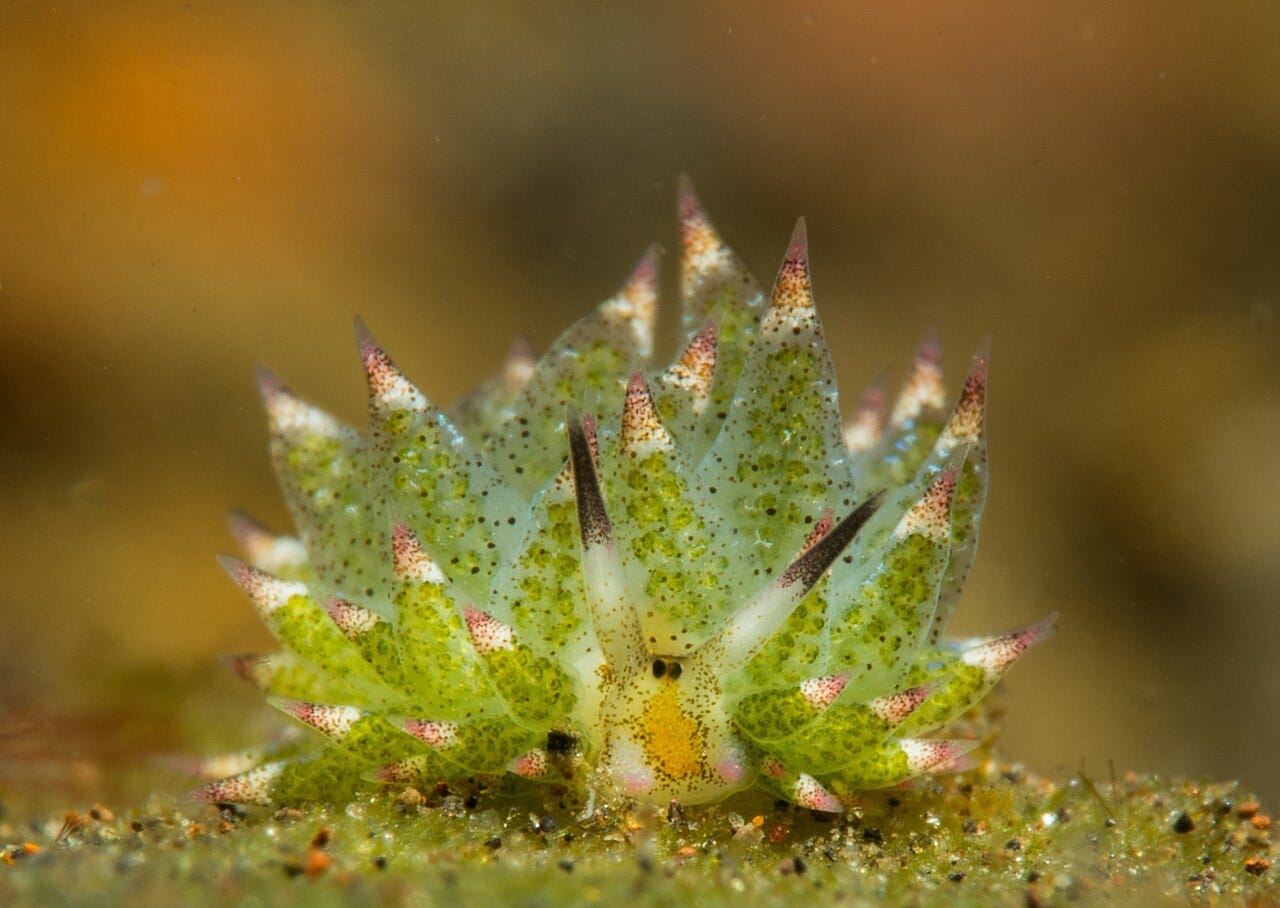
How exactly this has come about remains a mystery. Likely, it began in much the same way that the development of chloroplasts did; through a case of incomplete digestion. How the slug came to store them in its tissue it another matter, though no doubt a great deal of genetic trial and error was involved. Regardless, the potential benefit to the slug would seems apparent; a source of food during times of scarcity. Not enough to fully substitute for grazing, of course. Sunlight is a very diffuse resource and the amount of energy that can be harvested from so small a surface area is woefully insufficient to maintain animal metabolism (there is a reason plants don’t move much). But in the right environment, the right circumstances, it could be the difference between life and death.
What is especially remarkable is that the chloroplasts are able to persist for weeks, if not months, in this manner. As all cellular structures require the periodic replenishment of their components and the construction of new proteins, this would seem to imply that at least some of the genes necessary for chloroplast function are being retained by the slug. Since many of the necessary genes are not contained in the chloroplast itself but in the algal nucleus, some form of horizontal gene transfer must have taken place. How exactly the slug was able to steal genes away from its pilfered cargo is unclear, but time will certainly tell.
Granted, this is not yet a true endosymbiosis. The stolen chloroplasts cannot be maintained indefinitely and must be periodically replaced through the consumption of new algae. But there is no reason to think that, one day, it may evolve into one. That at some point in the perhaps not-so-distant future we may bear witness to another instance of a new type of Life coming into existence.
When do two species become one? Like in so much of biology, it is a difficult question to answer and I doubt that a sharp line can be drawn. No organism is truly independent. Every form of Life is part of an interconnected stream of flows of energy and matter. Flows which ultimately derive from other forms of Life. To what degree is a predator separate from its prey or a pollinator from its flower if it cannot live without it? The boundaries, while present, are fluid. Better I think to speak of when two separate processes have become so intertwined that to speak of them separately no longer makes sense.
Today, it is impossible to speak of human without mitochondria or plants without chloroplasts. We have absorbed them completely. Erased any semblance of their once free-living nature. They could not live without us even if they wanted to.
But of course, neither could we live without them. Whenever the process may have reached its stable conclusion, today we are no longer two species sharing a space but one integrated organism. To speak of humanity without mitochondria is a contradiction. We are an amalgam, a merger of two streams of life that have spent several billion years traveling together across the adaptive landscape of evolution. We will continue to do so. From Earth, to the stars, and whatever comes after.
Potentially answer, I should say. While the theory I present has many defenders, it is important to note that it has detractors as well and what really happened will likely never be known to us.